So I did a thing…
Interview on Radio Broadstairs (who can be found here www.radiobroadstairs.net) with Phil Richards
I discussed the coming Equinox, Aurora and the ‘Spring Triangle’
Equinox
20th March see the Spring equinox. Whilst it’s nothing you can actually ‘see’, it does affect us profoundly at this time of year. Have you noticed how much lighter it’s getting lately? Well at the equinox, the day and night are of equal length, but it’s the lengthening of the day which accelerates up until the 20th. At this time of year 4 mins is added to the length of daylight every day (and of course the night gets shorter by the same amount). Contrast this with the summer solstice – on June 20th this year – which is the ‘longest day’ and the winter solstice which is the ‘shortest day’ just before Christmas – 21 December. At these points the difference changes only about a second between days. So now it is really noticeable. The soil warms up and plants spring into life, the oceans start to warm up from this point onwards and sunsets and sunrises are at their quickest. But it really is a time to enjoy the coming longer evenings and warm weather.
But how does it happen?
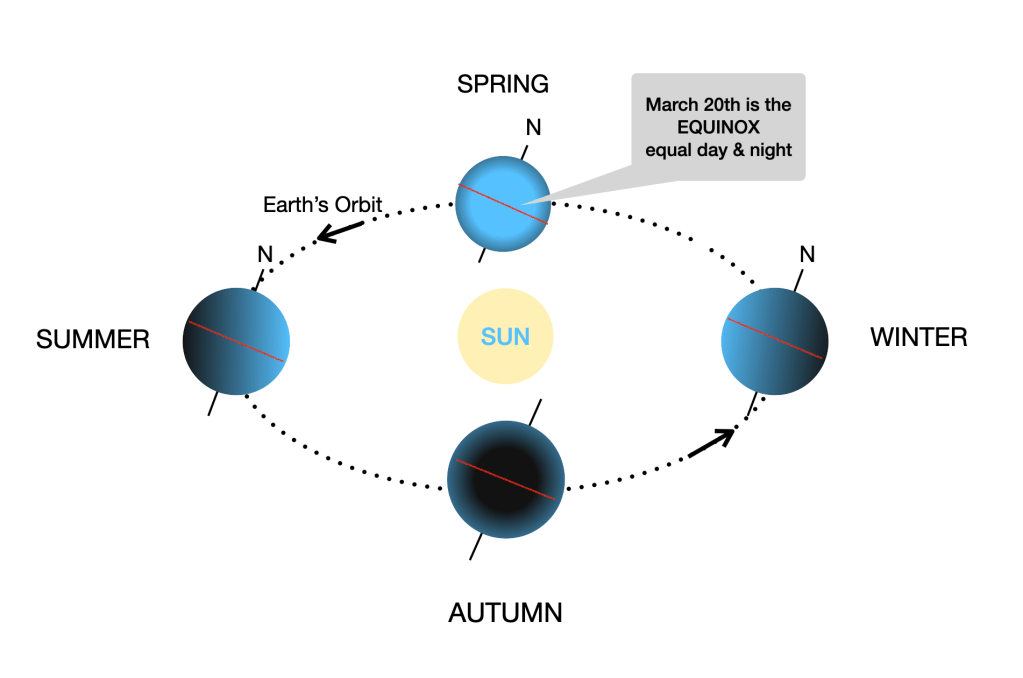
So as the Earth orbits the Sun through the year, the angle of its spin (23°) means in winter the lower (southern) hemisphere gets more daylight and in summer the northern hemisphere gets more sunlight. This gives us the seasons. A you can see, the equinox is exactly in between these points and we are now heading for summer.
Aurora
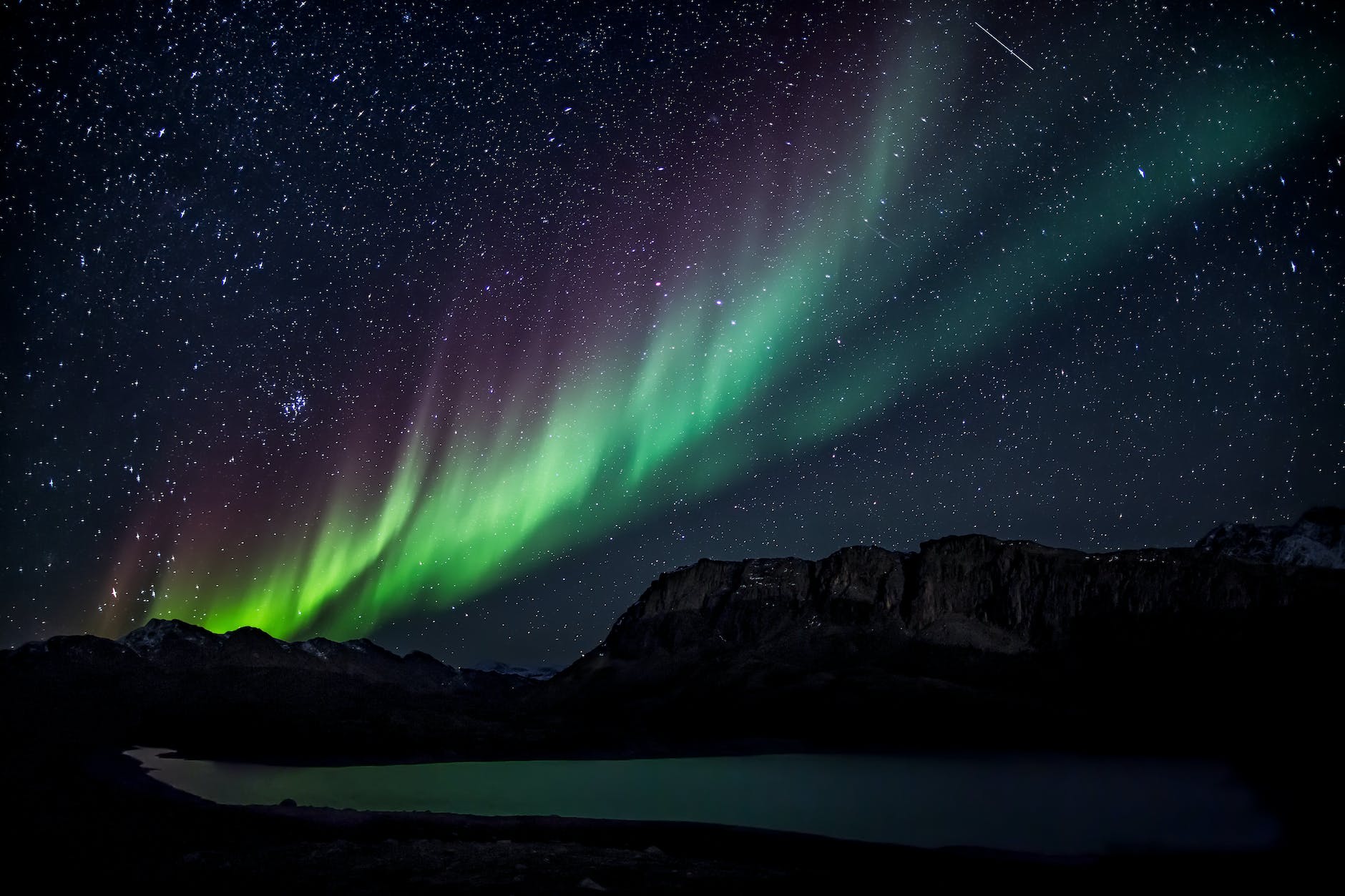
I’m seeing quite a few locals here in Kent talking on social media about seeing aurora – or ‘the Northern Lights’. This is incredible for such a southern part of the world. Usually this is reserved for more northern latitudes up near the Arctic Circle. What’s happening?
The Sun has an 11 year ‘Solar Cycle’ where activity on its surface increases and decreases – and we are building up to ‘Solar Maximum’ later this year. The surface of the Sun is incredibly hot of course, but all of the internal burblings can twist the magnetic field and create all sorts of things on the surface. Expect many more Sunspots, but also things called Coronal Mass Ejections or CMEs for short. These are a like a spurt of charged particles travelling at high speed out into space – and if they happen to point to Earth, then we get beautiful aurora. The bigger and more direct the CME, the brighter the aurora.
Aurora are caused by these charged particles smashing into the atmosphere and exciting the molecules up there. It’s the same process as switching on a fluorescent light tube, but a little more mysterious and awe inspiring.
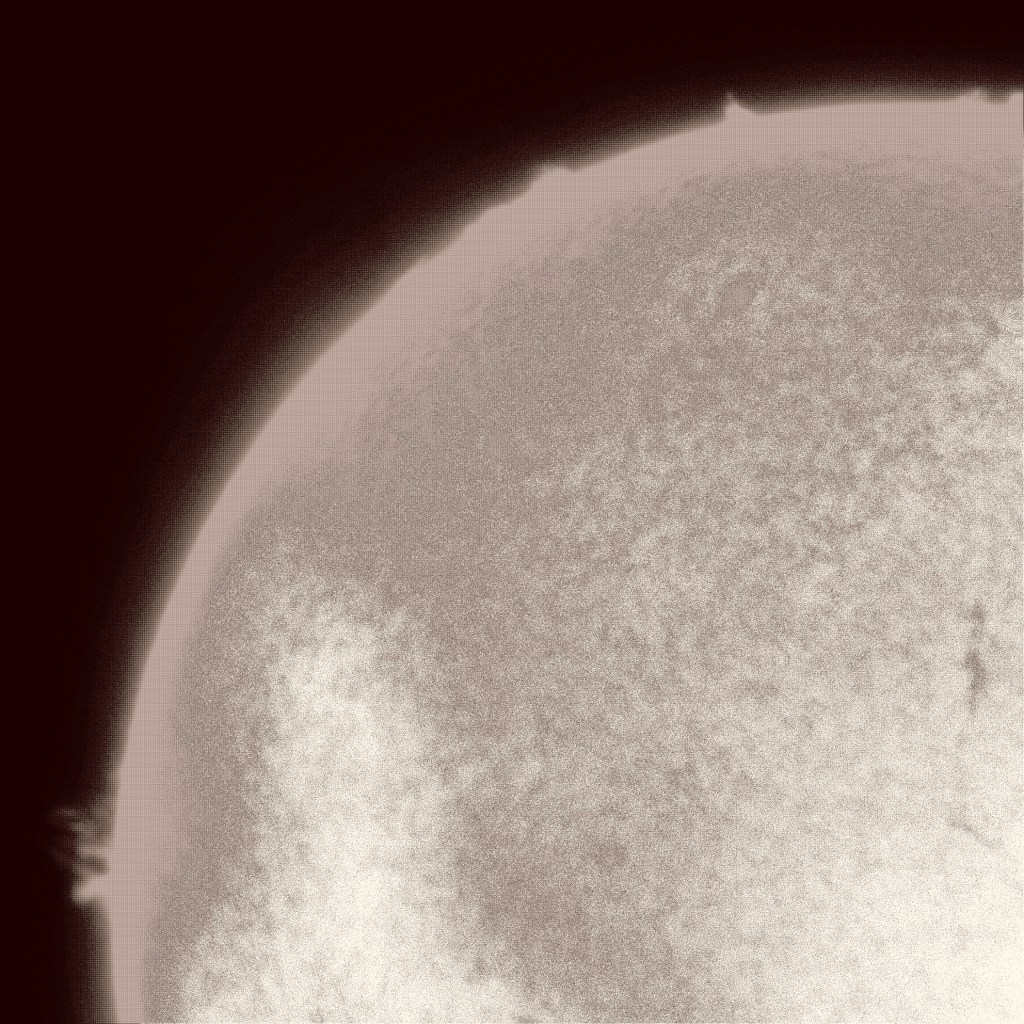
Sun’s surface showing prominences, taken by the author:
How to see: On a clear moonless night, look north and let your eyes adjust. Probably the best way to capture the finest of glows we are ever likely to get here is to photograph them. If you have a DSLR camera and a tripod, then use a nice wide angle lens, set the camera to ‘manual’ and focus to infinity with the aperture as open as possible. Use a lens cap so there is no incidental light hitting the lens, use a lens cap. Now play around with long exposures (30 seconds+) and fast film speeds (ISO 1600) and see what you can capture!
Skywatching
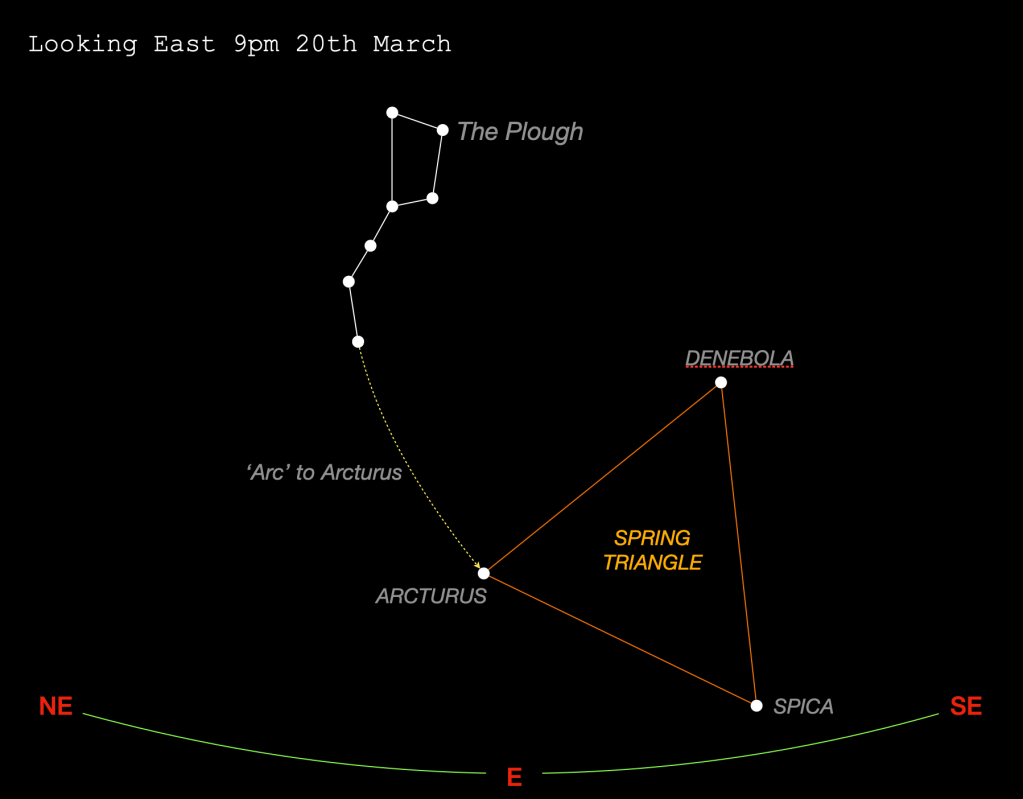
Not much to see in the way of planets or meteor showers this month, so let’s take a look at the Spring Triangle – a lovely asterism appearing this time of year.
First, find the Plough and if you take the arc of the saucepan handle and follow it round, you come to Arcturus – so the arc to Arcturus. This star is huge. Even at a distance of 37 light years it is the fourth brightest star we can see in our night sky. The bright Denebola is joined by Spica coming up over the horizon and is quite visible after 9pm making the Spring Triangle another reminder we are heading into warmer weather!
Looking forward, we have the newest of new moon’s on the 8th April – a total solar eclipse. Alas this is not visible from the UK, but I have booked my flight to the US and will report back next month on what we see.
Clear skies!
– Mark
 Astro Mark
Leave a comment