With only 16 sleeps left until the big solar eclipse day dawns, it’s time to start tidying up those loose ends and get straight.
The three of us are booked to fly into Chicago for 2pm on the Friday before, spend some time acclimatising to the foreign climes and local cuisine (hotdog at a ballgame) then get wherever the weather takes us to find a place to enjoy the event. What to plan for?
My first consideration is the images I’ll get. And whatever I take needs to fit into hand luggage as we are flying via Dublin so I don’t want anything in the hold.
So that takes out any idea of heavy duty tripods with tracking mounts and counter weights. It needs to be small and light, so it’s a help that we’re talking about the Suns and Moon. They do not need a huge scope to image. The 72mm APO refractor I have can sit perfectly happily on a standard camera, but to what end? I could take the hydrogen alpha filter, but I see little point as this is an eclipse and the idea of it is to look directly towards the Sun in visible light?
So I decided to leave these at home for this one. They can sit it out and wait for August 12, 2026 when an eclipse hits Spain just before sunset. That should be interesting low in the sky. August is a clear month in Spain and so I can imagine some really cool stuff to put in the foreground – that Goudi cathedral that’s taking forever to build maybe?
Back to the US. The eclipse is around lunchtime (depending on where we will be) and so it’s going to be high in the sky – a very steep 60°. I’ve decided to pack a standard camera, lens and tripod.
So the camera is a Nikon D5300. It’s a DSLR with an APSC sensor, meaning it’s not quite full frame (which is, the same sized sensor as the old 35mm film size). It’s 2/3rds the size, which makes the camera smaller and lighter (good) and when shooting on long focal length lenses, it increases the image size. I am taking the Sigma 600mm lens which means a 900mm effective focal length. That’s a long lens. It needs some support though and my lightweight Manfrotto tripod could never take the load so I’m stuck hauling the Manfrotto 055 tripod and here’s the problem bit of kit to travel with. It’s a superb tripod, but too big for hand luggage. So I’m taking the head off and taking the legs out to reduce the length so it can all fit into the case diagonally (ouch!). Then assemble on the other side of the pond.
Whilst we’re on about the tripod head, mine comes with the X-Pro three way, which is a brilliant head, but for astronomy? Not so much. It can’t move without untightening the handles first to unlock it and that makes realigning difficult. Not impossible by any means, but if you’re tracking the Sun across the sky by hand you will need to move in small, smooth increments.
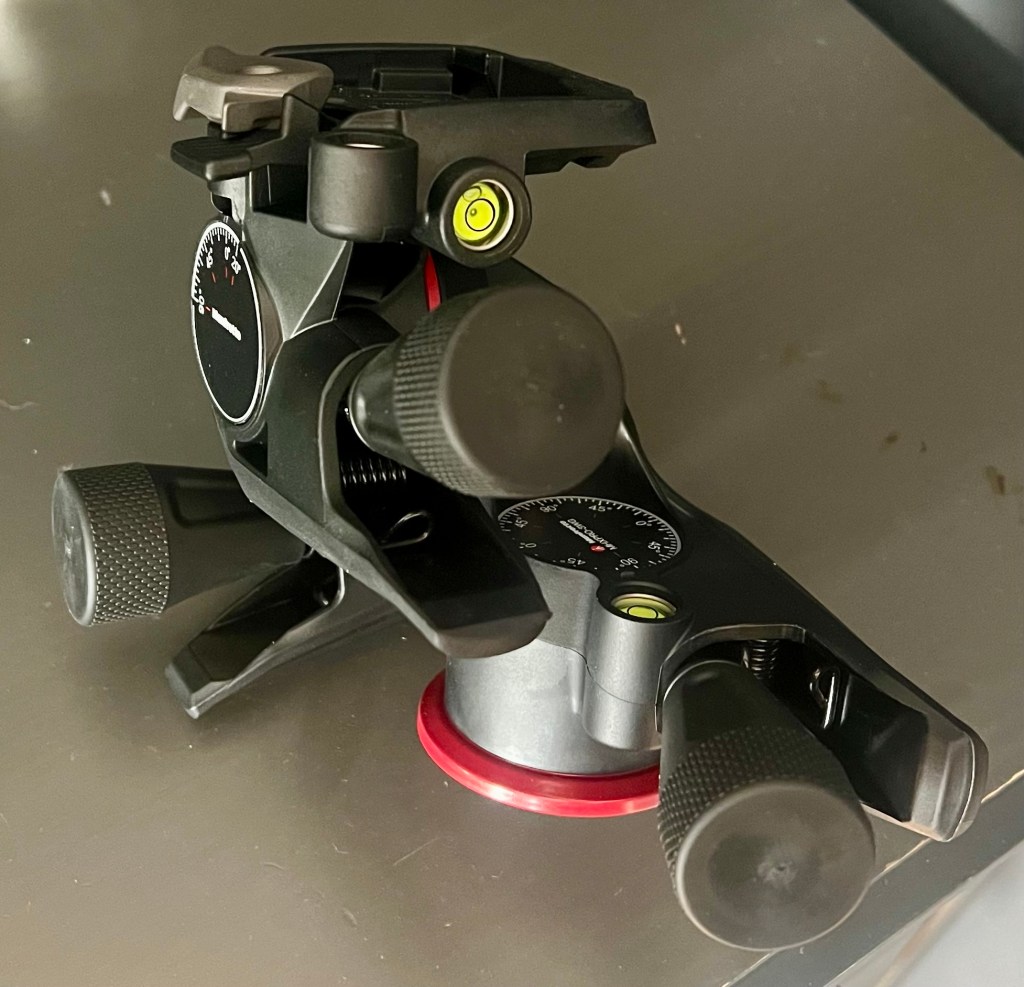
I purchased the X-Pro geared head. It is light, but very strong and more than enough to carry a large lens and camera. The gearing works smoothly and the only fault I can find is the design is for pointing the camera at a downward angle, so it only has the ability to raise 20°. But just turn the camera mount plate around and that solves that, you just need to adjust from the front of the camera not from behind. Very doable.
And so – filters? I could go with a neutral density filter. The 600mm lens takes a 95mm filter thread. I would prefer an adjustable ND filter. That way I can use it for all sorts of stuff? Nah. I don’t think I’d use an ND on a hyper-telephoto lens for long exposure shots. So I have chosen to buy a Baader Solar Filter film to go over the primary lens for the partial phases either side of totality. That’s 10% of the price of an ND filter and I could use it for the 72mm APO for white light solar imaging. Bingo!
Now alignment. What’s that you say? How difficult can it be aligning a scope or camera to include the Sun? Well, it’s difficult as the Sun is only the size of your fingertip at arm’s length and checking the shadow seldom works for me as there’s always too much kit and wiring and stuff in the way. So I’ve invested (well, asked for a birthday gift – thanks sis) in a Tele-Vue Sol Searcher. It’s basically crosshairs projected onto a wee screen. A crazily overpriced way to do something simple and I’m sure there are far cheaper versions out there, but this made an excellent gift as it will serve me well down the years and it will get me the shots I want of the eclipse. also: Tele-Vue – yay!
So that’s the main imaging train sorted. On to how to planning the shot and other ways of getting the eclipse captured for posterity shortly.
 Astro Mark
Leave a comment